
Interior demolition
Interior Demolition in Brooklyn
Breakara strips out interiors across Brooklyn, in buildings where the walls are lath and plaster, the stairs are the only way out, and the neighbour is on the other side of the wall.
Tell us what is coming out
One wall, one apartment or a whole floor. Call and describe the building.
What interior demolition is
Interior demolition means taking the inside of a building apart and leaving the structure standing. Walls, ceilings, floors, kitchens, bathrooms, fixtures and finishes come out. The things holding the building up stay exactly where they are.
People also call it a strip-out or a gut. A gut usually means everything back to the studs and the subfloor. A strip-out can be partial, like clearing one apartment or removing a single wall to open two rooms into one. We do both and the difference is scope, not method.
The skill in it is knowing what is structural and what is not. In a Brooklyn row house that is not always obvious from the room, because walls get added, openings get closed up and previous work gets covered over.
Who we do this for
Owners renovating
You are gut renovating a house or an apartment and need it cleared properly before anything new goes in.
Landlords and managers
A unit needs stripping between tenancies or before a larger refit, in a building that stays occupied.
Contractors and architects
You need the strip-out done and cleared on schedule so the trades behind you are not standing in a pile of plaster.
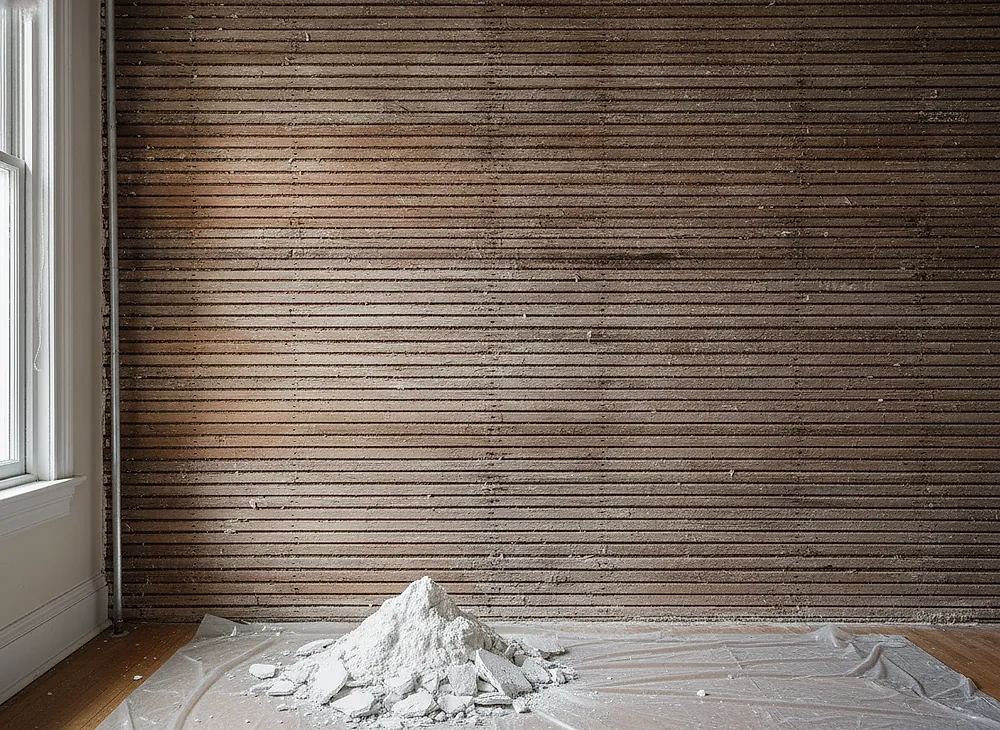
Lath and plaster is the thing people do not expect
More than half of Brooklyn's buildings went up before 1930, and in that stock the interior walls are not drywall. They are plaster laid over thin timber strips called lath, nailed across the studs.
It matters for three reasons. It is far heavier than drywall, so the same room produces much more weight to carry out. It breaks into dust rather than into sheets, so containment has to be real rather than a sheet taped over a doorway. And it hides things, because a century of work sits behind it.
We open a small area first and look before we quote the whole room. Finding out what is behind the wall on day one is much cheaper than finding out halfway through.
How we work through it
-
1
We look at what is holding the building up
Before anything comes out we work out which walls carry load, where the joists run, and what has been altered before. A wall that looks like a partition is not always a partition.
-
2
We find the services
Gas, water, waste and electrics get traced and isolated. In older buildings the runs are rarely where the drawings say.
-
3
We seal and protect
The work area is closed off. The stair, the hallway, the entrance and the floors on the route out are covered, because those are the parts of the building everybody else still has to use.
-
4
We strip in order
Fixtures and fittings first, then finishes, then the walls and ceilings. Working in order keeps the material sorted and keeps the weight moving out steadily instead of all at once.
-
5
We clear as we go
Material leaves the building through the day rather than piling up. On a narrow lot with one stair, letting it accumulate is what turns a four-day job into a seven-day one.
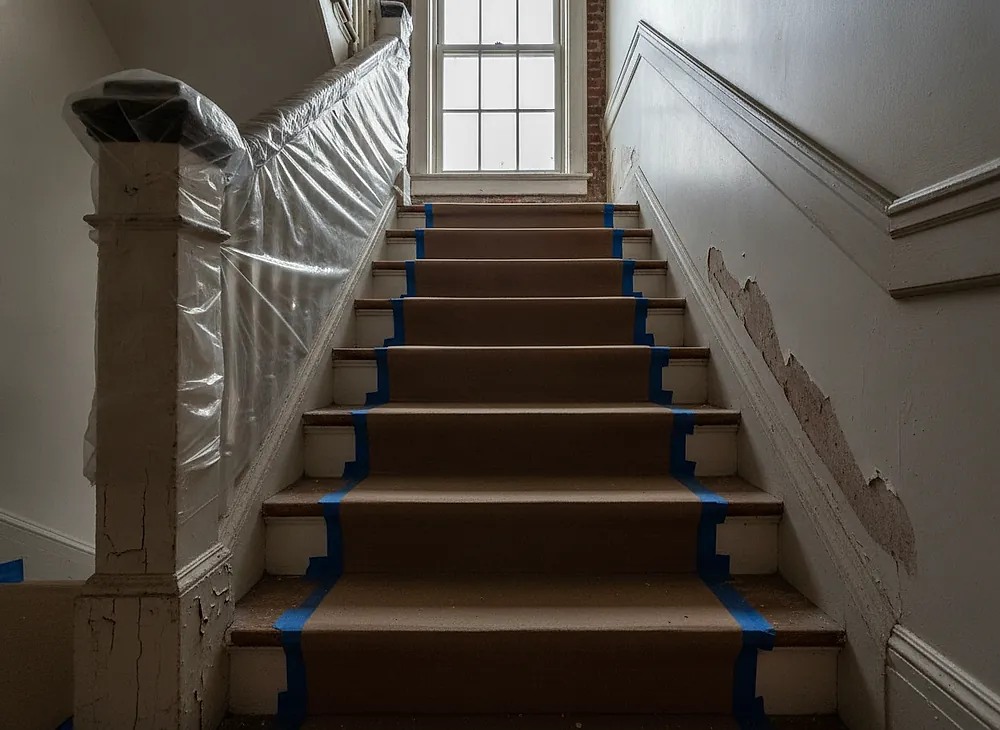
Getting it out of a 20-foot-wide house
Around two thirds of Brooklyn lots are 25 feet wide or narrower. There is no driveway, no side alley and usually no rear vehicle access. Whatever comes out of the building goes down the stairs, through the front door and across the sidewalk.
In a walk-up there is no elevator either, and walk-up apartment buildings are the second most common building type in the borough. Every bag is carried.
So the route out is not an afterthought, it is the thing that decides the sequence and the timeline. We plan it first, protect it properly, and keep it clear while the work runs.
Not sure what is behind your walls?
Tell us the age of the building and we will tell you what to expect.
Working next to your neighbour
On an attached building the wall at the side of your house is shared. The plaster on your side is yours. The wall itself is holding up two buildings.
We treat anything beyond that wall as something to protect. That means knowing which side of it we are working on, keeping the vibration down when we are cutting close to it, and not opening anything through it.
We also tell you what will be loud and roughly when, so you can give your neighbours some warning. It costs nothing and it prevents most of the trouble that comes up on attached lots.
What decides the cost of interior demolition in Brooklyn
Every demolition company in this city answers the price question by asking you to call, and it is worth explaining why rather than just repeating it. The things that move an interior demolition price are almost all invisible in a description. Two jobs described in identical words can differ by a factor of three once someone has actually looked at the building. So instead of a number we cannot stand behind, here is exactly what your job depends on, in the order it usually matters.
How much material there is. Not floor area. Volume and weight of what is actually coming out. A large room stripped of very little is a smaller job than a small room taken back to the studs.
What it is made of. This is the one that catches people. More than half of Brooklyn predates 1930, and in that stock the walls are plaster on timber lath. Plaster weighs far more than drywall, breaks into dust rather than sheets, and needs proper containment.
What floor it starts on. Walk-up apartment buildings are the second most common building type in the borough. If there is no elevator, every pound is carried down by hand, and that is time.
How far it has to be carried. Two thirds of Brooklyn lots are 25 feet wide or narrower, so there is usually no side or rear access. The route runs through the front of the building and across the sidewalk.
What has to be protected. Stairs, hallways, shared entrances, finished floors that are staying, and anything on the far side of a party wall.
What is behind the surface. Load-bearing walls, services running where no drawing shows them, and previous alterations hidden under the finish. This is why we open a small area and look before committing to a whole room.
We do not publish prices, because a price we have not looked at is a guess and you would be right not to trust it. What we will do on the phone is tell you which of these your job is heavy on, and that usually narrows it a long way before anyone visits.
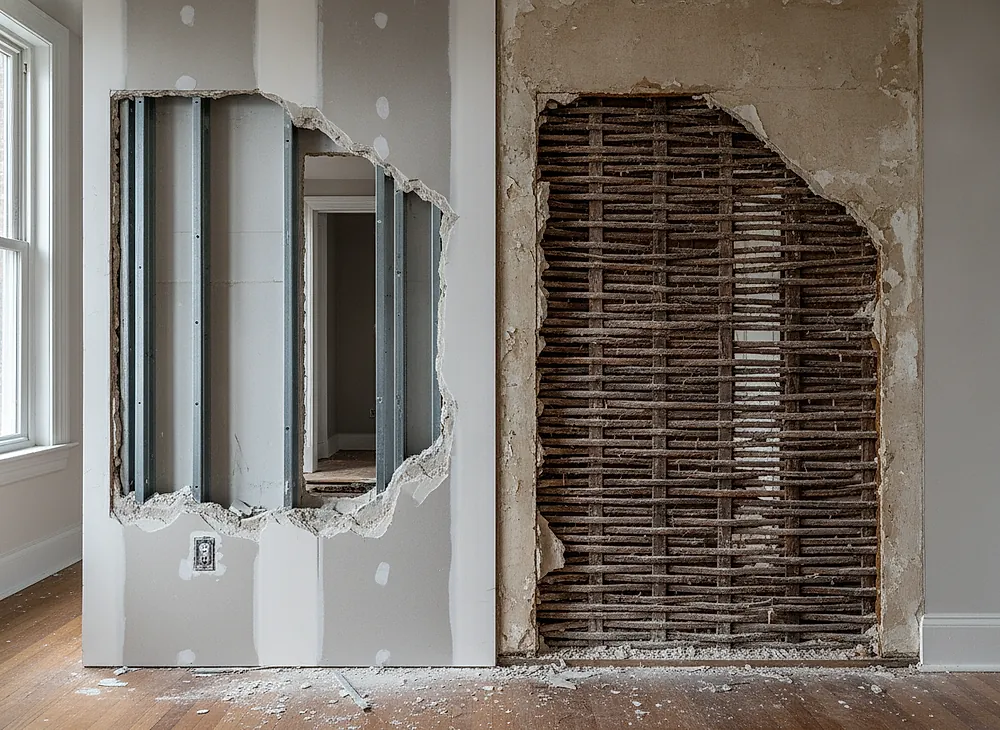
The same room, two different jobs
Take a 12 by 14 room, stripped back to the studs.
In a 1990s building on the second floor with a service elevator, the walls are drywall. The material comes off in sheets, goes into the elevator and out to a container at the kerb.
In an 1890s row house on the fourth floor of a walk-up, the same room is plaster on lath. It produces roughly three times the weight, all of it dust and rubble rather than sheets, and every bag goes down four flights past two other apartments whose stairs have to be covered first.
Nothing in the description of the room changed. The job did, completely.
What changes the timeline, separately from the cost
These overlap but they are not the same list. A job can be expensive and quick, or cheap and slow. A single wall is usually a day. A full apartment gut runs from a few days upward, and the building decides more of that than the square footage does.
What stretches a timeline is usually access rather than volume. A single stair shared with residents means material moves in controlled runs rather than continuously. A narrow street with no parking means loading happens in windows. The other one is what we find: if a wall turns out to be carrying load, or there are live services where nothing was expected, that becomes a separate piece of work before the demolition continues.
Before you call, three photographs tell us more than any measurement: the room, the doorway into it, and the stair or hallway leading out of the building. Add roughly when the building went up, which floor the work is on and whether there is a lift, and whether anyone is living there. Ten minutes on the phone with those will tell you what your job depends on.
Interior demolition questions
How much does it cost to demolish a wall?
It depends first on whether the wall is carrying load. A partition coming out is straightforward. A load-bearing wall needs support put in before anything is removed and that is a different piece of work.
After that it is the same drivers as any other job. What the wall is made of, what floor it is on, and how the material gets out of the building.
Is interior demolition the same as a gut?
A gut is one kind of interior demolition, the one where everything comes out back to the structure. Interior demolition also covers partial work, like clearing a kitchen or taking out one wall.
How much dust will there be?
Plaster makes a lot of it, which is why containment matters more in this building stock than it would elsewhere.
We seal the work area rather than draping it, keep the dust down while we work, and clean the route out at the end of each day.
Can you work in an occupied building?
Yes, and most of the time that is what we are doing. Two-family houses are the most common building type in Brooklyn, so there is often somebody living upstairs or next door.
We keep the shared parts of the building usable and protected for the whole job.
Do you take the material away as well?
Yes. Clearing is part of the job, not a separate thing you arrange afterwards. Construction material cannot go out with the building's household rubbish, so it is handled properly from the start.
What is the average cost for interior demolition?
There is no useful average, and an average across this borough would mislead you rather than help.
The spread inside Brooklyn alone is very wide, because the building matters more than the room. A published average would be a number drawn from jobs that have nothing in common with yours.
Why is plaster more expensive to remove than drywall?
Weight and containment. Plaster over lath is far denser than drywall, so the same room produces much more to carry out.
It also breaks into dust rather than sheets, so sealing the work area is real preparation rather than a formality.
Does a walk-up really cost more?
Yes, and it is one of the larger differences. Everything that comes out of a building with no elevator is carried down by hand.
On a fourth-floor apartment that is a substantial share of the total labour on the job.
Tell us about the strip-out
What is coming out, what floor it is on, and how old the building is. That is enough to start.