
Construction debris removal
Construction Debris Removal in Brooklyn
Breakara clears the material a demolition job produces, in Brooklyn buildings where everything comes down the stairs and out through the front door.
Tell us what is there
What the material is, what floor it is on, and how it can leave the building.
Clearing is part of the job
When we strip out an interior or take a structure down, the material that comes out leaves with us. It is one job rather than two, and you are not left with a pile in the hallway to sort out afterwards.
We also clear sites where the work has already been done and the material is still sitting there. That happens often enough to be worth saying: a job stalled, a contractor left, or a renovation produced more than anyone expected.
Either way the question is the same. What is it, how much of it is there, and how does it get out of the building.
Why it cannot go out with the building's rubbish
Construction and demolition material from professional work is not collected as household waste in New York City. It does not go out with the bags on collection day and it is not part of a bulk pickup.
That is the single most useful thing to know if you are renovating for the first time. People fill the kerb with plaster and timber, and it stays there.
It is why clearing is planned as part of the work from the beginning rather than dealt with at the end.
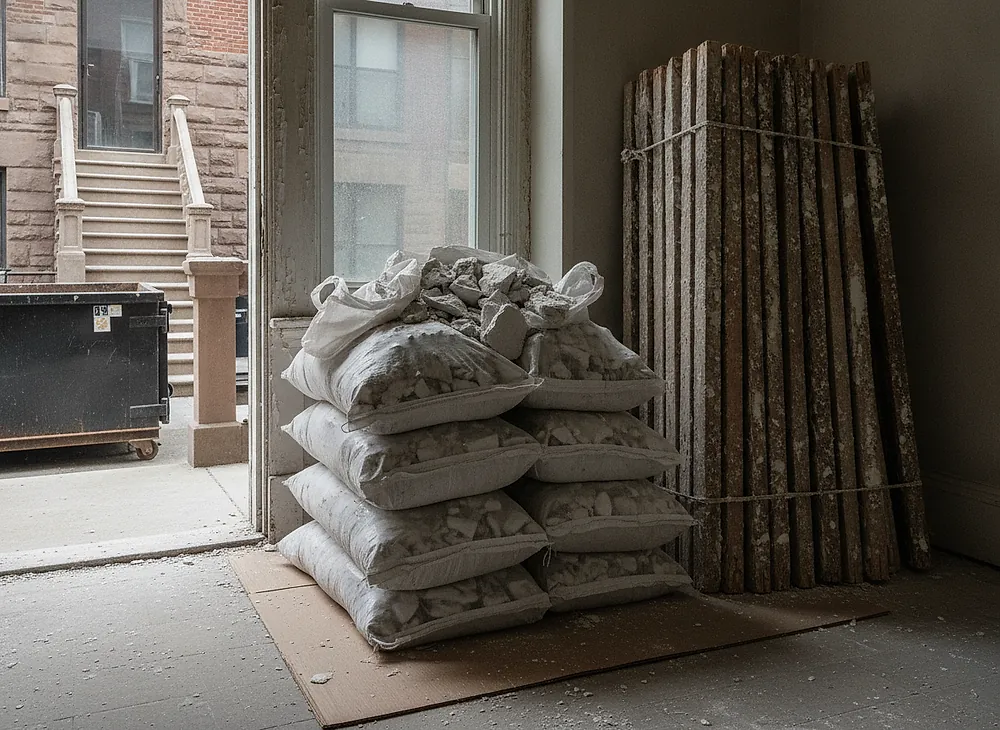
Volume is deceptive and weight is what counts
A stripped room does not look like much when it is still on the walls. Broken up and bagged, it fills far more space and weighs far more than people estimate.
Plaster is the main reason. More than half of Brooklyn's buildings predate 1930 and are finished in plaster over timber lath rather than drywall. Plaster is dense, and a single room of it can outweigh the entire contents of a modern apartment.
Concrete is worse again. A small rear yard slab can weigh more than everything else on the job put together.
How clearing runs on a Brooklyn job
-
1
We work out the route first
Which stair, which door, how wide the hallway is and where a container can sit. Everything else follows from that.
-
2
We protect the route
Stair treads, handrails, hallway floors, doorframes and the shared entrance. These are the parts other people in the building still have to use every day.
-
3
We contain and bag as we go
Material is broken down and contained where it is produced rather than dragged loose through the building.
-
4
We keep it moving
It leaves through the day instead of accumulating. On a single-stair building, letting it pile up is what makes a job overrun.
-
5
We leave it swept
The work area and the whole route out are cleaned at the end, not just the room you were paying attention to.
There is nowhere to put it on most lots
Most Brooklyn lots are 25 feet across or less. There is no yard to stage material in, no driveway to load from, and nowhere on the property to leave a container.
So staging happens inside the building on protected floors, and the material goes out to the kerb in a controlled way rather than being carried out piecemeal all day.
Time on the street matters on a residential block, so we plan for it to be short and tidy rather than open-ended.
Tell us what is in the building
What the material is and what floor it is sitting on.
What decides the scope, the time and the cost
How much material there is, what it is made of, what floor it starts on and how far it has to be carried before it can be loaded.
Material type does most of the work in that list. Plaster and concrete are heavy. Timber, cabinetry and fixtures are bulky but light. A room of one is a very different job from a room of the other.
After that it is the carry. A ground-floor room with a wide doorway moves fast. Fourth-floor walk-up with a turn in the stair is not, and no amount of equipment changes that.
Debris removal questions
How do you dispose of construction debris in NYC?
Not through household collection. Construction and demolition material from professional work is not picked up with residential rubbish and is not part of a bulk collection.
It has to be arranged as part of the work, which is why we treat clearing as part of the job rather than something that happens afterwards.
How much does it cost to remove construction debris?
Volume, material and carry distance. A room of plaster and a room of kitchen units take up similar space and weigh completely differently.
The floor you are starting from matters as much as the amount. Everything in a walk-up is carried.
Can I just put it out with the trash?
No. It will not be collected and it will sit on the kerb. It is worth knowing before you start rather than after the first room is down.
Will there be a container on my street?
Usually yes, for as short a time as we can manage. On a narrow residential block that matters to everyone living on it, so we plan the loading rather than leaving it open-ended.
Do you clear a site somebody else worked on?
Yes. If a job stopped part way and the material is still in the building, that is a clearing job and we take it.
What about the stairs and the hallway?
They get covered before anything is carried through them, and they get cleaned at the end of each day.
In a shared building that is not a courtesy, it is the difference between a job that causes complaints and one that does not.
Tell us what needs clearing
What the material is, what floor it is on, and how it can get out.