Building demolition
Building Demolition in Brooklyn
Breakara takes structures down across Brooklyn, on attached lots and narrow streets where what stays standing matters as much as what comes down.
Tell us about the structure
What it is, what is attached to it, and what the street is like. Call and describe it.
Whole structures and parts of them
Building demolition means the structure itself comes down rather than just what is inside it. That can be the whole thing, or a defined part of it such as a rear extension, an outbuilding, or an upper storey.
The line against a strip-out is simple. If the walls and floors that hold the building up are staying, that is interior demolition. If they are coming out, it is this.
Most people know which one they need. If you are not sure, describe what you want the lot or the building to look like afterwards and we will tell you which job it is.
The three kinds of job
Full
The whole structure comes down to the lot, foundations included where that is what you need.
Partial
A defined part goes and the rest stays. Rear extensions, additions and outbuildings are the common ones here.
Selective
Specific structural elements are removed while the building stays standing, usually to make room for something new.
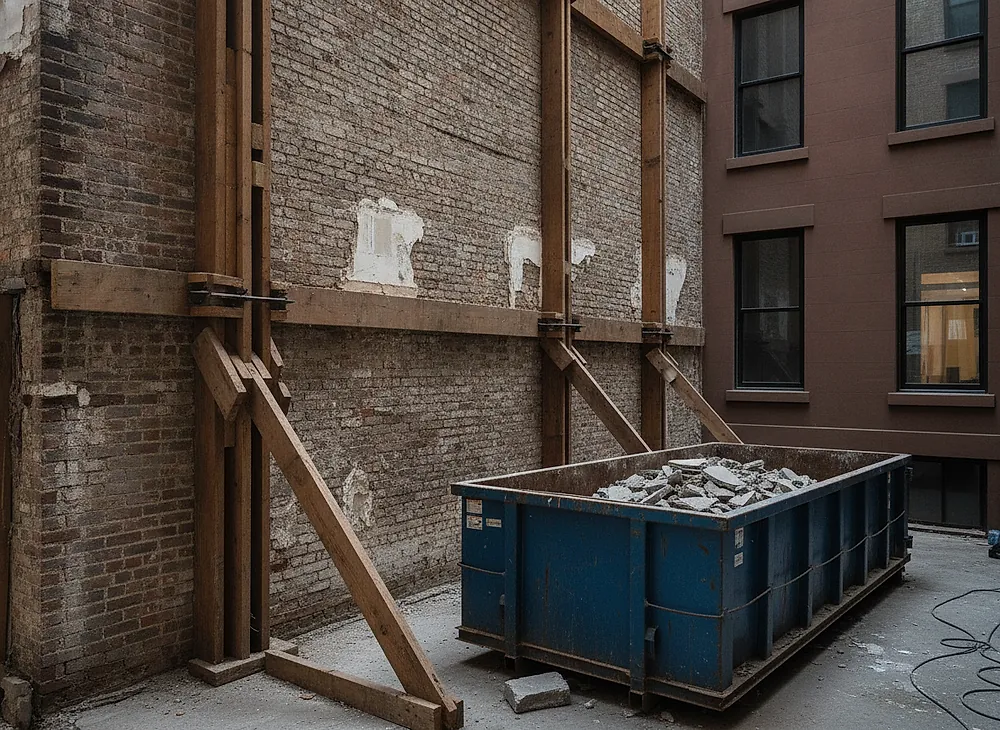
Almost every Brooklyn lot is attached
Around two thirds of lots in the borough are 25 feet wide or narrower, and most of what sits on them is attached or semi-attached. That means the wall at the side is doing a job for two buildings, not one.
When a structure comes down between two others, the work is as much about the two that stay as the one that goes. The shared wall has to stay supported, weatherproof and stable at every stage, not just at the end.
That is why the sequence matters more than the equipment. Things come down in an order that keeps the remaining structure stable throughout, rather than in whatever order is quickest.
How the work runs
-
1
We survey what is attached
What shares a wall, what shares a foundation, and what is tied into the structure that should not be. On older Brooklyn stock the answer is often not what the lot lines suggest.
-
2
We plan the sequence
The order things come down in is the whole plan. It keeps the neighbouring buildings supported at every stage rather than only at the end.
-
3
We work out access
Street width, parking, overhead lines and how much of the sidewalk can be used. That decides what can reach the lot and what has to be done by hand.
-
4
We protect and separate
The shared wall, the neighbouring roofs, the sidewalk and anything on the far side of the boundary.
-
5
We take it down and clear the lot
The structure comes down and the material goes with it. Clearing is part of the job.
What the street decides
On a wide street with a driveway, machinery can reach the structure and most of the work is mechanical. On a 20-foot frontage in the middle of a terrace with cars on both sides, much more of it is done by hand and the material has to be moved further before it can be loaded.
Neither is a problem. They are just different jobs with different timelines, and knowing which one you have is most of the estimate.
So when you call, tell us how wide the street is, whether there is any rear or side access, and whether anything can be parked outside. Those three answers tell us a great deal.
Tell us what it is attached to
The street, the neighbours and the structure. That is where we start.
If your building is in a historic district
Brooklyn has 42 designated historic districts, and the first one in the whole city was Brooklyn Heights back in 1965. Park Slope, Cobble Hill, Carroll Gardens, Fort Greene, Boerum Hill and Stuyvesant Heights are all designated too.
If your building sits inside one, what can be done to the outside of it is governed separately from ordinary building rules. That is a fact about your property rather than about the work, and it is worth establishing early, because it shapes what is possible before anyone plans anything.
Tell us if you know your block is landmarked and we will factor it into what we discuss.
What decides the scope, the time and the cost
The size of the structure, what it is built from, what it is attached to, what can reach the lot, and how far material has to travel before it can be loaded.
Masonry and concrete structures produce far more weight than timber-framed ones of the same size, and weight is what drives the removal side of the job.
Timing runs from a few days for a small rear structure upward. Access and attachment move it more than floor area does. The material leaves the lot the same way the crew came in, and on an attached lot that route is the number.
Building demolition questions
What are the three types of demolition?
In practice, full, partial and selective. Full means the whole structure. Partial means a defined section comes out and the rest stays. Selective means specific structural elements are removed while the building remains standing.
Interior demolition is often counted as a fourth, and it is the one where nothing structural is touched at all.
My building is attached on both sides. Is that a problem?
No, it is the normal case in Brooklyn. It changes the method rather than ruling the job out.
The shared walls stay supported through the whole sequence and are made weathertight where they end up exposed.
Do the foundations come out too?
They can, and whether they should depends on what is going on the lot afterwards. If you are building again, what happens to the existing footings is worth deciding before the structure comes down rather than after.
How much of the street will be taken up?
As little as the job allows and for as short a time as possible. On a narrow residential street that is a real constraint and we plan around it.
Tell us about parking and street width when you call, because it changes the approach.
What happens to everything that comes down?
It leaves with us. Clearing the lot is part of the work, and construction material cannot be put out with a building's household rubbish.
Talk to us about the structure
What is coming down, what it is attached to, and what the street is like.