
Concrete removal
Concrete Removal in Brooklyn
Breakara breaks out and removes concrete across Brooklyn. Slabs, yards, walkways, steps and footings, including lots where the only route out runs through the house.
Tell us what the slab is
Where it is, roughly how thick, and how you would get to it. Call and describe it.
What we take out
Rear yard slabs, front walkways and paths, driveways and parking pads, steps and stoops, cellar floors, machine bases, and footings and foundations left behind by something that is already gone.
This is contractor work rather than a collection service. We break the concrete out, load it and take it away as one job.
If what you actually have is a few broken pieces from work somebody else did, that is a clearing job and it sits with our debris work instead. Either way, describe it and we will tell you which one it is.
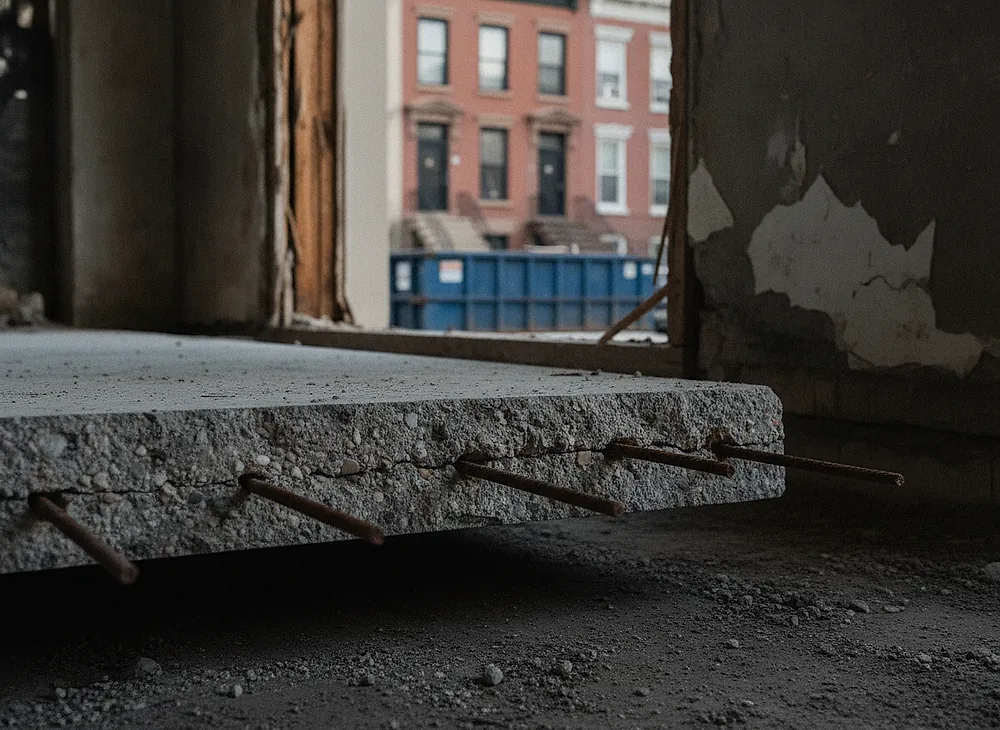
Concrete is a weight problem, not an area problem
People estimate concrete by looking at the surface. The surface is the least important measurement. What matters is how thick it is and what is inside it.
A four-inch slab and a seven-inch slab across the same yard are not remotely the same job, and neither looks any different until you break into it. If there is reinforcing bar through it, every piece has to be cut free rather than lifted out.
That is why we ask about thickness and what the concrete was for. A path and a machine base look similar from above and behave completely differently once you start.
How we approach it
-
1
We check what is under it
Services run under yards and driveways more often than people expect. Water, gas, drainage and old fuel lines all turn up. We establish what is down there before breaking anything.
-
2
We check what is in it
Thickness, reinforcement and whether it was poured in one piece or in sections. That decides the method and most of the timeline.
-
3
We work out the route
On a Brooklyn lot the rear yard often has no way out except through the building. That single fact changes the job more than the size of the slab does.
-
4
We protect the route
If broken concrete is coming through your hallway, the floor, the stair and the doorways get covered first.
-
5
We break, load and clear
It comes out in pieces sized for the route, not for convenience, and it leaves with us.
The rear yard with no way out
This is the most common concrete job in Brooklyn and the one people underestimate most. The slab is behind the house. There is no side alley, no rear gate onto a road, and the lot next door is somebody else's.
So the only route is through the building. Every piece of that slab is carried through the ground floor, along the hallway, out the front door and across the sidewalk.
It is completely doable and we do it regularly. It just means the size of the pieces is set by the width of your hallway, and the protection inside the house is a real part of the work rather than a formality.
Tell us how someone reaches the slab
Through the house, down a driveway, or straight off the street.
What decides the scope, the time and the cost
Thickness, reinforcement, total volume, what is underneath, and the route out. Volume and route matter most.
Because concrete is dense, a small area can produce a great deal of weight, and weight is what has to be carried and hauled. A modest rear yard can outweigh the entire contents of a stripped apartment.
On timing, a walkway or a set of steps is usually a day. A full rear yard with no vehicle access takes longer, and the hallway route is the reason rather than the breaking itself.
Concrete removal questions
How much do they charge to remove concrete?
It comes down to volume and access rather than surface area. Thickness, whether there is reinforcing bar through it, and how far each piece has to be carried are the things that move it.
A yard you can reach with a vehicle and a yard reached only through the house are very different jobs at the same square footage.
How do you get rid of large amounts of concrete?
It is broken into pieces sized for the route out, carried or loaded, and hauled away. On a lot with no vehicle access the piece size is set by the doorways and the hallway.
It never goes out with a building's household rubbish. Construction material is not collected that way in the city.
How can I safely remove old concrete myself?
The two risks people underrate are what is underneath and how much the pieces weigh. Services run under yards and driveways, and a piece of slab that looks liftable frequently is not.
If you are set on doing it yourself, establish what is buried under it first and keep the pieces much smaller than you think you need to.
Can you get to a rear yard with no side access?
Yes. It is the usual situation in Brooklyn. The route runs through the building, and the ground floor gets protected properly before anything is carried through it.
Do you take out footings and foundations?
Yes, including footings left behind by a structure that is already gone. Whether they need to come out depends on what is going on the lot next, which is worth deciding early.
Tell us about the concrete
Where it is, roughly how thick, and how someone would get to it.